

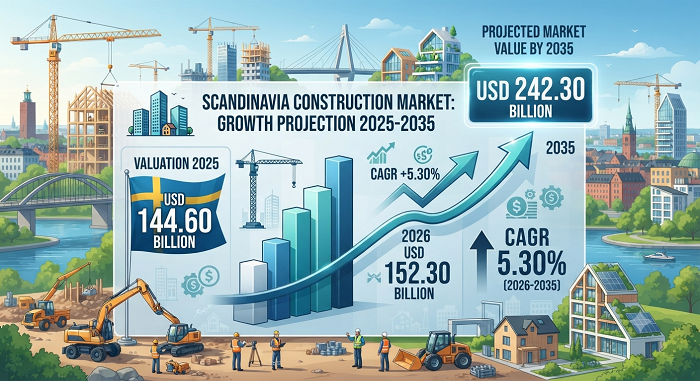
Scandinavia Construction Market Projected to Grow from USD 152.30 Billion in 2026 to USD 242.30 Billion by 2035
Scandinavia Construction Market
Key Drivers of Market Growth
The market's expansion is propelled by a powerful combination of government policy, technological adoption, and pressing societal needs.
1. Mega Infrastructure and Transport Plans
The most significant driver is the wave of national transport investment. Norway's updated National Transport Plan (2025–2037) commits a staggering NOK 1.3 trillion to road, rail, and coastal infrastructure, ensuring a multi-decade pipeline of heavy-civil projects . Similarly, Sweden's railway expansion, including the SEK 95 billion East Link high-speed corridor, guarantees long-term order-book visibility for tunneling, bridgework, and station construction . These programs collectively form the bedrock of the market.
2. Energy-Performance Retrofit Mandates
Aligning with the revised EU Energy Performance of Buildings Directive (EPBD), Scandinavian countries are aggressively tackling building emissions. Mandates require the worst-performing buildings to achieve higher energy classes by 2030-2033 . Denmark has operationalized this through its 2025 Climate Act amendments, which tie building permits to whole-life carbon thresholds . This regulatory push creates a consistent pipeline of renovation work, insulating the market from cyclical downturns in new builds.
3. The Data-Center and Power-to-X Boom
Scandinavia's abundant low-carbon electricity and cool climate have made it a prime location for hyperscale data centers. With an estimated USD 12 billion in announced projects, this sector is a major growth area . Concurrently, investments in green hydrogen and e-fuel synthesis plants add a specialized industrial construction dimension to the pipeline, further diversifying the market.
Get Sample @ https://www.marketresearchfuture.com/sample_request/25886
Market Segmentation: A Deeper Dive
The market exhibits clear trends across different sectors and construction methods.
By Sector: The Infrastructure sector is the dominant force, commanding a 48% share of the market in 2025 . However, the Residential sector is projected to be the fastest-growing (6.30% CAGR) , rebounding from a sharp downturn caused by high interest rates . Structural housing shortages in Stockholm, Oslo, and Copenhagen underpin this recovery.
By Construction Type: New construction held a 55% share in 2025, driven by greenfield transport and data-center projects . Yet, Renovation is a key growth segment (5.40% CAGR) , fueled by the aforementioned energy-performance mandates and a growing focus on circular economy principles .
By Construction Method: While conventional on-site methods still dominate (74% share), Modern Methods of Construction (MMC) are expanding rapidly at a 7.50% CAGR . Factory-fabricated modules, mass-timber systems, and Building Information Modeling (BIM)-integrated workflows are being adopted faster here than anywhere else in Europe to address labor shortages and productivity goals .
Country-Level Dynamics: A Tale of Three Nations
While interconnected, each Scandinavian country has a unique construction profile.
Sweden is the largest market, commanding a 41% revenue share in 2025. Its growth is driven by large-scale rail projects, defense infrastructure modernization following NATO accession, and a robust data-center sector. The residential market is poised for recovery as interest rates ease .
Norway is the fastest-growing country at a 6.50% CAGR through 2035. Its pipeline is anchored by the massive National Transport Plan and onshore construction tied to offshore-wind development in the North Sea. Defense spending also adds significant volume .
Denmark contributes 27% to the market, with key projects including the Copenhagen metro Line M5 extension and participation in the Fehmarn Belt fixed link. The country is a leader in circular construction and low-carbon building practices, driven by its stringent 2025 Climate Act .
Buy Now @ https://www.marketresearchfuture.com/checkout?currency=one_user-USD&report_id=25886
Challenges and Opportunities: Navigating the Future
Despite its strengths, the market faces challenges, including severe skilled-labor shortages, volatile material costs (especially timber and steel), and permitting delays . However, these challenges are creating fertile ground for innovation and new opportunities.
Key opportunities include:
Industrialized Housing at Scale: Leveraging Scandinavia's deep prefabrication culture to cut build times and address housing backlogs .
Circular Construction: Capitalizing on mandates for material reuse, creating margin advantages through valorized waste streams .
Digital Twin and BIM Monetization: Moving from design to operational asset management, creating new, recurring revenue streams .
Green Bond Financing: Aligning with climate-linked lending to gain preferential access to capital .
Offshore-Wind Onshore Construction: Capitalizing on the rapid buildout in emerging Norwegian regions .
Read More @ https://www.marketresearchfuture.com/reports/scandinavia-construction-market-25886
Future Outlook
The future of the Scandinavia construction market is one of continued, innovation-led growth. The transition to an electrified economy will create a secondary wave of construction demand for grid substations and district-energy networks. AI-augmented project delivery and the scaling of mass-timber construction will drive efficiency and carbon reduction . As ESG reporting becomes mandatory, contractors who can document their sustainability performance will gain a significant competitive edge.
Browse More Reports:
tetraethyl benzene market https://www.marketresearchfuture.com/reports/tetraethyl-benzene-market-33528
US Semiconductor Fabrication Materials market https://www.marketresearchfuture.com/reports/us-semiconductor-fabrication-materials-market-17601
US Titanium Dioxide market https://www.marketresearchfuture.com/reports/us-titanium-dioxide-market-14207
Copper Mining Market https://www.marketresearchfuture.com/reports/copper-mining-market-9812
shape memory polymer market https://www.marketresearchfuture.com/reports/shape-memory-polymer-market-41337
chemical management service market https://www.marketresearchfuture.com/reports/chemical-management-service-market-32173
Isoprene Market https://www.marketresearchfuture.com/reports/isoprene-industry-4799
Market Research Future
Market Research Future
+1 855-661-4441
email us here
Legal Disclaimer:
EIN Presswire provides this news content "as is" without warranty of any kind. We do not accept any responsibility or liability for the accuracy, content, images, videos, licenses, completeness, legality, or reliability of the information contained in this article. If you have any complaints or copyright issues related to this article, kindly contact the author above.
