

Long Fiber Thermoplastics Market Size (USD 6.42 billion by 2035), Segments, Regional Insights, and Outlook Through 2035
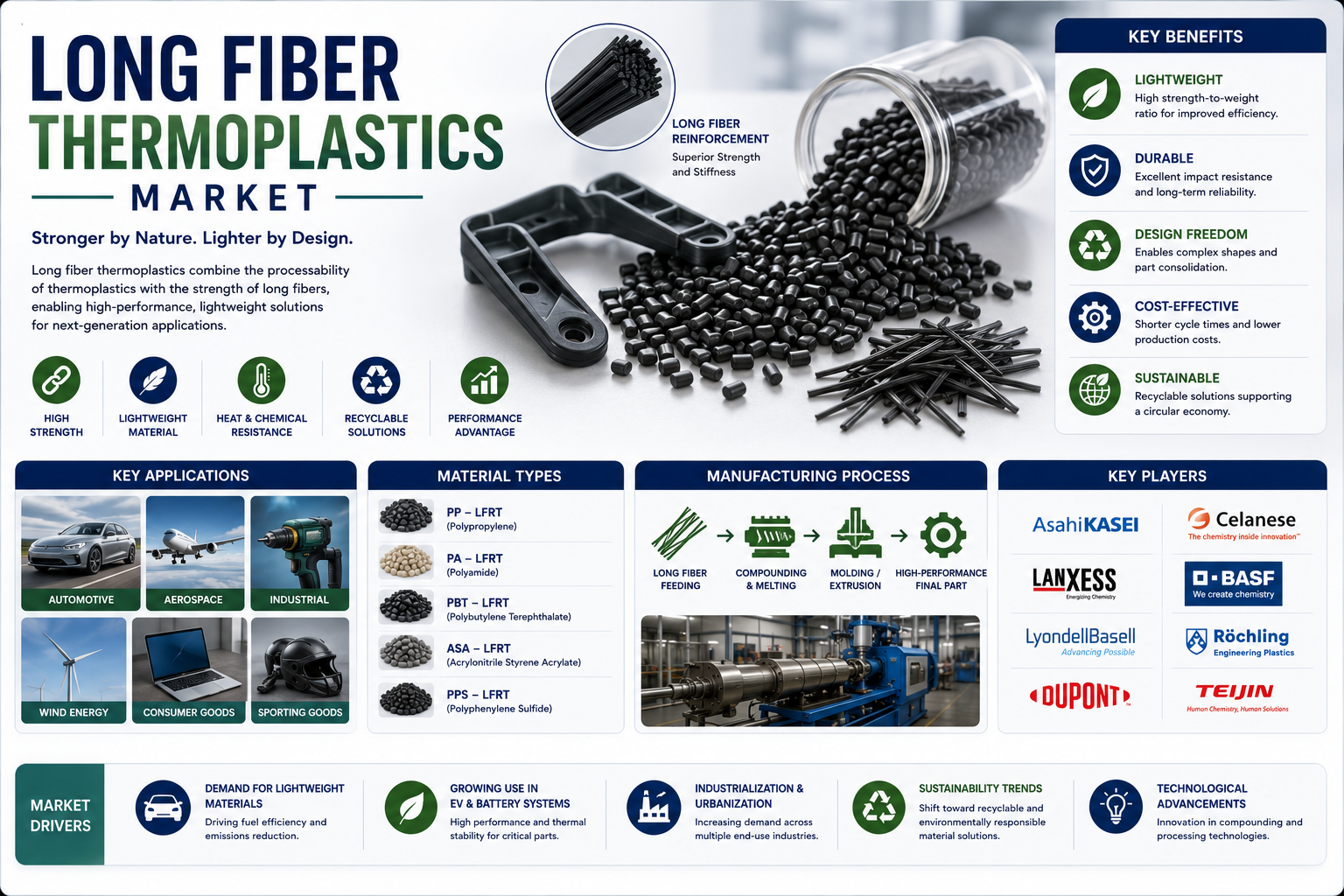
Long Fiber Thermoplastics Market (2026 - 2035)
Europe leads the Long Fiber Thermoplastics Market with a 35% share, anchored by OEM lightweighting mandates.
NM, UNITED STATES, July 30, 2026 /EINPresswire.com/ -- The long fiber thermoplastics market reached an estimated USD 3.42 billion in 2025 and is projected to grow from USD 3.64 billion in 2026 to USD 6.42 billion by 2035, registering a compound annual growth rate of 6.5% during the forecast period. Stringent automotive emissions standards, including the EU's Euro 7 framework and U.S. CAFE targets, are compelling OEMs to adopt lighter structural materials, and long fiber thermoplastics sit at the intersection of weight reduction and cost efficiency. Government-backed lightweighting initiatives across major auto-producing nations continue to funnel R&D funding into this space.A pronounced shift away from traditional metal stampings and short-fiber compounds toward continuous-fiber-reinforced alternatives is reshaping the market. Automakers alone have committed over USD 4.8 billion in lightweighting programs through 2030, creating a pull effect that benefits producers scaling up direct-inline compounding and pultrusion technologies. Aerospace interior programs and electronics housings are adding incremental demand channels.
Europe commands the largest regional share at roughly 35% of the market, driven by Germany's automotive cluster and Italy's appliance sector. Asia-Pacific is the fastest-growing region with a projected CAGR of 7.8%, fueled by China's EV expansion and India's infrastructure build-out. North America holds the second-largest share, near 27%, anchored by pickup-truck underbody shields and consumer electronics enclosures. The decade ahead will be defined by capacity expansions in Southeast Asia and circular-economy formulations in Europe.
Market Segmentation
By Resin Type
Polypropylene-based long fiber thermoplastics hold the dominant share at approximately 48% of the market, reflecting the resin's cost-to-performance advantage in automotive under-hood and structural parts. PP delivers the lowest cost per unit stiffness among commodity resins, and automotive front-end carriers, door modules, and instrument-panel carriers overwhelmingly specify PP-based formulations due to their recyclability and sub-1.2 g/cm³ density. Polyamide is the fastest-growing resin segment, holding about 28% share and posting a projected 7.4% CAGR, as demand rises for heat-resistant components in EV powertrains; it is gaining ground in under-hood environments where continuous operating temperatures exceed 150°C, a thermal threshold polypropylene cannot meet, with EV inverter housings and motor brackets representing the highest-growth application pocket through 2035. Polybutylene terephthalate holds about 14% share, valued for the dimensional stability it brings to electronics applications, while other resin types, including specialty grades, account for the remaining 10%, serving niche industrial applications.
By End-User Industry
The automotive sector accounts for roughly 45% of global demand and is projected to grow at a 6.3% CAGR through 2035, reinforced by regulatory pressure to cut vehicle mass. It remains the single largest consumer within the market, and regulatory mandates, from Euro 7 in Europe to China's Phase VI emissions standards, leave OEMs with few practical alternatives to fiber-reinforced polymers for mass reduction at scale. Aerospace applications are growing at a 7.0% CAGR, driven by interior cabin upgrades and emerging urban air mobility programs. Electrical and electronics applications are expanding at a 7.1% CAGR, the fastest of any end-user segment, supported by 5G infrastructure rollouts and miniaturized housing designs; small-cell enclosures, server-rack brackets, and EV charging-station housings all demand the stiffness, flame retardancy, and weight savings that long fiber thermoplastics deliver. Buildings and construction is growing at a 6.8% CAGR, tied to modular and prefabricated building systems, sporting equipment is growing at a 5.9% CAGR on premium consumer-goods design trends, and other end-user industries, including industrial machinery and agricultural equipment, are growing at a 5.5% CAGR.
Get Report Sample Copy with TOC: https://www.marketresearchfuture.com/sample_request/4889
Regional Market Analysis
Europe leads the market with a 35% share in 2025, anchored by OEM lightweighting mandates. Germany accounts for about 32% of the European market, home to the automotive corridor stretching from Munich to Wolfsburg, which remains the single largest concentration of consumption globally; the region is further supported by the European Commission's Critical Raw Materials Act, which incentivizes domestically sourced glass-fiber production. The United Kingdom holds about 14% of the European market, driven by aerospace and EV start-up activity, France holds roughly 13%, tied to Renault-Stellantis lightweighting programs, and Italy holds about 11%, reflecting its appliance and sporting-goods manufacturing base. Spain accounts for around 9% of the European market through automotive transplant factories, the Nordic countries hold about 8% on sustainability-driven material substitution, Russia holds roughly 5% tied to import substitution in oil and gas fittings, and the rest of Europe accounts for about 8%, spread across diverse industrial applications.
North America holds the second-largest global share at approximately 27%. The United States accounts for the majority of North American demand at a 6.2% CAGR, propelled by GM, Ford, and Stellantis specifying long fiber thermoplastics for structural brackets across their next-generation truck platforms. Canada is growing at a 5.8% CAGR, tied to automotive parts exports and oil and gas pipe fittings, while Mexico is growing fastest in the region at a 6.9% CAGR, as its emerging role as a nearshoring hub pulls compounding investment southward, with two new production lines announced in Nuevo León and Puebla since 2023.
Asia-Pacific holds about 25% of the global market and is the fastest-growing region overall, projected to expand at a 7.8% CAGR through 2035. China leads regional growth at an 8.1% CAGR, reflecting its dual role as the world's largest auto producer and fastest-scaling EV manufacturer, with new-energy-vehicle production exceeding 12 million units annually. India is growing at a 7.6% CAGR, driven by its Production-Linked Incentive scheme for advanced automotive components, worth INR 26,000 crore, which is drawing compounders to Gujarat and Tamil Nadu. Japan is growing at a 5.4% CAGR on high-precision electronics housings, South Korea at a 6.0% CAGR tied to EV battery structural frames, ASEAN at a 7.3% CAGR on greenfield auto-assembly foreign direct investment, and the rest of Asia-Pacific at a 6.5% CAGR amid general industrialization.
South America holds about 7% of the global market. Brazil dominates the region with roughly 62% of South American share, supported by its Inovar-Auto and Rota 2030 programs, which reward OEMs that reduce fleet emissions and indirectly boost adoption in local assembly plants; the region remains price-sensitive, favoring polypropylene-based grades over costlier polyamide variants. Argentina holds about 22% of regional share, tied to automotive exports and appliance production, while the rest of South America accounts for roughly 16%, spread across construction and consumer-goods applications.
The Middle East and Africa region holds about 6% of the global market, remaining nascent but growing as construction booms create demand for corrosion-resistant profiles. Saudi Arabia is growing at a 6.8% CAGR, backed by its Vision 2030 industrial plan, which allocates over USD 6 billion to local manufacturing clusters, including polymer compounding facilities near Jubail. The UAE is growing at a 6.3% CAGR on construction and electronics assembly, South Africa at a 5.5% CAGR tied to automotive OEM exports, Egypt at a 6.1% CAGR on building-materials import substitution, and the rest of the region at a 5.7% CAGR amid general industrial growth.
Growth Drivers
Automotive lightweighting regulations represent the most significant growth driver, contributing an estimated 1.8 percentage points to CAGR globally over the short term. The EU's proposed Euro 7 standards and the U.S. National Highway Traffic Safety Administration's updated CAFE targets for 2027 and beyond mandate fleet-average CO2 cuts of up to 15% relative to 2021 baselines. Each kilogram of metal replaced by long fiber thermoplastics in structural brackets or seat frames can reduce per-vehicle mass by 20–40%, making regulatory compliance a direct demand catalyst for the market.
EV platform proliferation contributes an estimated 1.4 percentage points to CAGR, concentrated in Europe and China over the medium term. Battery-electric vehicles require aggressive mass compensation to offset pack weight, and European OEMs have announced over 40 dedicated EV platforms slated for production by 2028, many specifying glass-fiber-reinforced polypropylene for front-end carriers and battery-tray inserts. China's new-energy-vehicle penetration, now above 35% of new-vehicle sales, adds a further demand layer.
5G and electronics miniaturization contributes roughly 0.7 percentage points to CAGR in North America and Asia-Pacific over the medium term, as fifth-generation telecom infrastructure demands lightweight, EMI-shielding enclosures that traditional metals struggle to deliver cost-effectively; polyamide-based formulations provide the requisite stiffness-to-weight ratio for small-cell housings and base-station brackets, a segment the FCC projects will require over 1.5 million additional macro sites in the U.S. alone by 2030.
Infrastructure modernization in emerging markets adds an estimated 0.6 percentage points to CAGR across Asia-Pacific and South America over the medium term, while direct-inline compounding cost reduction contributes roughly 0.5 percentage points globally over the short term; advances in this technology, where continuous glass rovings are wet-out and pelletized in a single extrusion step, have reduced pellet conversion costs by roughly 12% since 2021, lowering the price gap versus short-fiber grades. Aerospace interior upgrades round out the driver set at an estimated 0.5 percentage points in North America and Europe over the long term, alongside recycled-LFT circular mandates contributing about 0.4 percentage points in Europe over the long term.
Purchase Now: https://www.marketresearchfuture.com/checkout?currency=one_user-USD&report_id=4889
Restraints
High tooling and processing costs represent the most significant restraint, subtracting an estimated 0.9 percentage points from CAGR globally over the short term. Long fiber pellets require specific injection molding machinery, with low-shear screws and larger gate designs to preserve fiber length, and the capital requirements for a production-grade molding cell may exceed USD 1.2 million, around 30% more than a comparable short-fiber cell. This cost premium is a deterrent for small and mid-size molders, hampering growth in emerging nations.
Raw-material price volatility subtracts roughly 0.6 percentage points from CAGR globally over the short term. Glass-fiber roving prices changed 18–22% between 2022 and 2024, influenced by energy prices at European furnaces and Chinese anti-dumping duties, while polypropylene resin pricing tracks the broader crude-oil matrix; these oscillations squeeze compounder margins and complicate long-term supply contracting.
Limited recyclability perception subtracts an estimated 0.5 percentage points from CAGR in Europe over the medium term, competition from continuous-fiber composites subtracts roughly 0.4 percentage points in North America and Europe over the long term, as continuous-fiber thermoplastic tapes and organo-sheets offer improved stiffness for large structural elements and are seeing some applications, particularly underbody shields, shift toward them as tape-placement robot costs decline. A shortage of trained mold-design engineers subtracts about 0.3 percentage points in Asia-Pacific over the medium term.
Competitive Landscape
The market exhibits low concentration, with no single player commanding more than 10% of global revenue; the estimated top-five share sits near 35–40%, with a long tail of regional compounders serving local OEM clusters. Competition centers on resin-fiber formulation expertise, inline compounding technology, and proximity to automotive assembly hubs.
SABIC leads with an estimated 7–9% revenue share, offering LNP Verton long-fiber polypropylene and polyamide compounds through an integrated resin-to-compound value chain. Celanese Corporation holds roughly 6–8% share, supplying Celstran LFT-PP and LFT-PA pellets backed by a global technical-service network. BASF SE holds an estimated 5–7% share through its Ultramid and Ultracom systems, differentiated by R&D-driven automotive Tier-1 partnerships. Lanxess AG holds roughly 4–6% share, known for Tepex continuous and long-fiber composites and its position as a hybrid molding technology leader. Solvay holds an estimated 4–6% share with its Xencor and specialty polyamide grades, anchored in an aerospace-grade flame-retardant portfolio.
PlastiComp, part of PolyOne/Avient, holds roughly 3–5% share through its Complēt long-fiber compounds, offering custom formulation for niche applications. RTP Company holds an estimated 3–5% share with its RTP 100-series product family, emphasizing rapid prototyping and small-lot capability. Daicel Corporation holds roughly 2–4% share through its Plastron pellets, leading Asia-Pacific distribution, Sumitomo Chemical holds an estimated 2–4% share with its Sumika Super LFT grades tailored for inline compounding at Japanese OEMs, and Kingfa Science & Technology rounds out the top ten with roughly 2–3% share, supplying cost-competitive PP-LFT and PA-LFT grades at high volume for Chinese EV makers.
Report Summary: https://www.marketresearchfuture.com/reports/long-fiber-thermoplastics-market-4889
Recent Industry Developments
In June 2026, SABIC launched a 50%-recycled-content LNP Verton grade targeting European OEM circular-economy specifications. In October 2024, BASF SE partnered with a major German automaker to co-develop polyamide-based battery-tray inserts for a 2027-model-year battery-electric vehicle platform. In April 2024, the European Commission published a draft revision of the End-of-Life Vehicles Regulation requiring 25% recycled-plastic content in new vehicles by 2030, boosting the demand outlook for recycled long fiber thermoplastics. And in September 2023, PlastiComp, operating under Avient, introduced a carbon-fiber long fiber thermoplastic pellet series for aerospace interior brackets, targeting FAR 25.853 compliance.
Related Report
aerospace high performance thermoplastics market https://www.marketresearchfuture.com/reports/aerospace-high-performance-thermoplastics-market-24824
thermoplastics micro molding market https://www.marketresearchfuture.com/reports/thermoplastics-micro-molding-market-30710
US High Temperature Thermoplastics market https://www.marketresearchfuture.com/reports/us-high-temperature-thermoplastics-market-20422
High Temperature Thermoplastics Market https://www.marketresearchfuture.com/reports/high-temperature-thermoplastics-market-4963
US Long Fiber Thermoplastics market https://www.marketresearchfuture.com/reports/us-long-fiber-thermoplastics-market-16897
Market Research Future
Market Research Future
+1 855-661-4441
email us here
Legal Disclaimer:
EIN Presswire provides this news content "as is" without warranty of any kind. We do not accept any responsibility or liability for the accuracy, content, images, videos, licenses, completeness, legality, or reliability of the information contained in this article. If you have any complaints or copyright issues related to this article, kindly contact the author above.
