

Digital Health Monitoring Devices Market Size to Reach USD 35.12B by 2035 from USD 7.40B in 2026 (CAGR 18.90%)
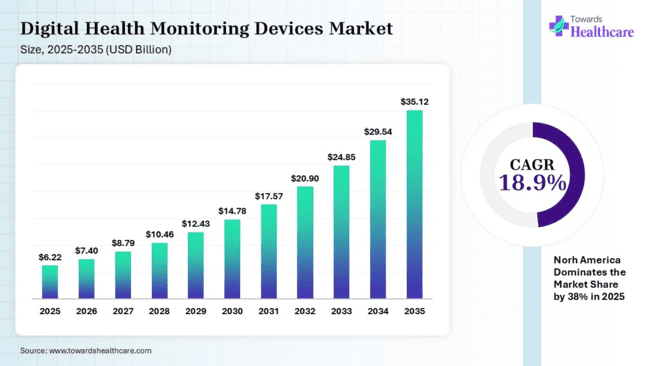
The global digital health monitoring devices market size was valued at USD 6.22 billion in 2025 and is predicted to hit around USD 35.12 billion by 2035, rising at a 18.90% CAGR, a study published by Towards Healthcare a sister firm of Precedence Research.
Ottawa, April 14, 2026 (GLOBE NEWSWIRE) -- The global digital health monitoring devices market size is calculated at USD 7.40 billion in 2026 and is expected to reach around USD 35.12 billion by 2035, growing at a CAGR of 18.90% for the forecasted period.
The Complete Study is Now Available for Immediate Access | Download the Free Sample Pages of this Report @ https://www.towardshealthcare.com/download-sample/6128
The U.S. Food and Drug Administration (FDA) advances the development of safe, innovative, and effective medical devices integrated with sensor-based digital health technology. The U.S. FDA has also published a list of medical devices that meet the FDA’s premarket requirements, which include non-invasive or minimally invasive medical devices, and wearables such as bands, patches, smartwatches, and rings. This list further includes medical devices that are designed for continuous or spot check monitoring of health parameters of individuals, and that can be used in non-clinical settings like the home. Furthermore, the most commonly used remote patient monitoring devices are the blood pressure cuff, glucometer, pulse oximeter, ECG+stethoscope, wearables like activity trackers, thermometer, and scale.
The Digital Health Monitoring Devices Market: Highlights
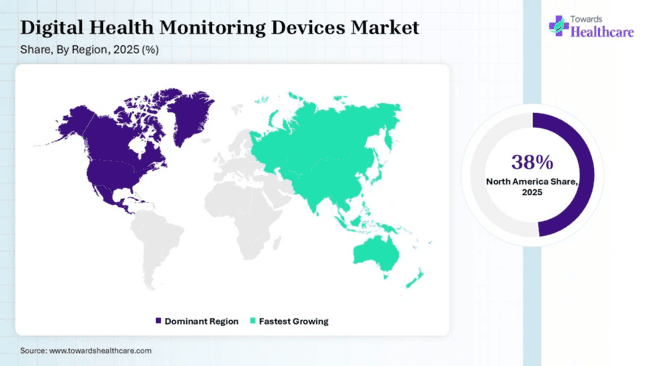
- North America held a major revenue share of 38% in the digital health monitoring devices market in 2025.
- Asia-Pacific is expected to witness the fastest growth during the predicted timeframe.
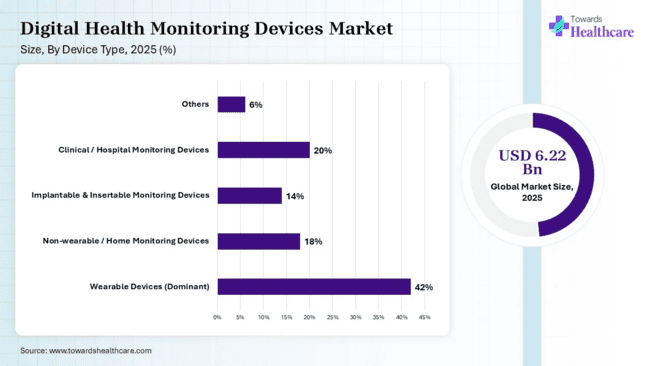
- By device type, the wearable devices segment registered its dominance by 42% over the global market in 2025.
- By device type, the wearable patches & adhesive biosensors sub-segment is expected to be the fastest-growing segment during the forecast period.
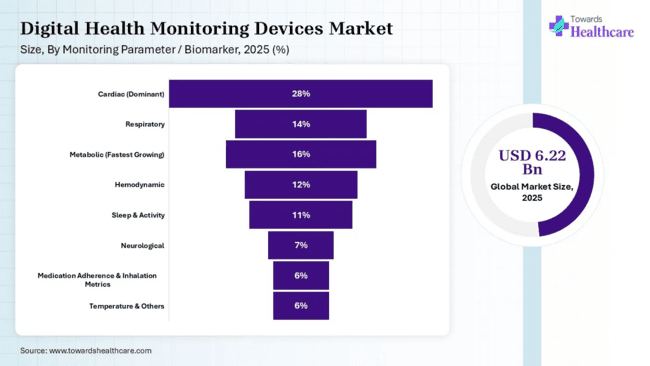
- By monitoring parameter/biomarker, the cardiac segment held the largest revenue share by 28% in the market in 2025.
- By monitoring parameter/biomarker, the metabolic segment is expected to show the fastest growth over the forecast period.
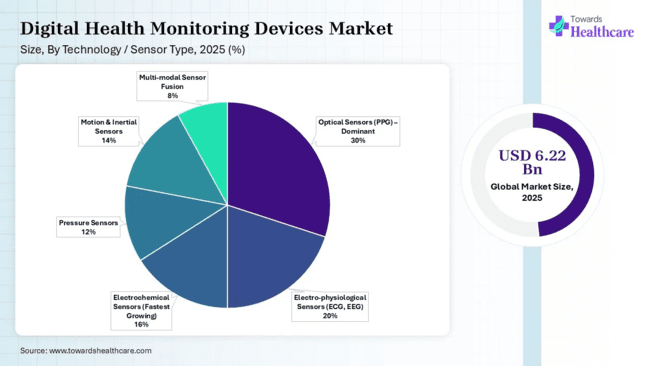
- By technology/sensor type, the optical sensors (PPG) segment held a dominant presence by 30% in the digital health monitoring devices market in 2025.
- By technology/sensor type, the electrochemical sensors segment is expected to witness the fastest growth in the market over the forecast period.
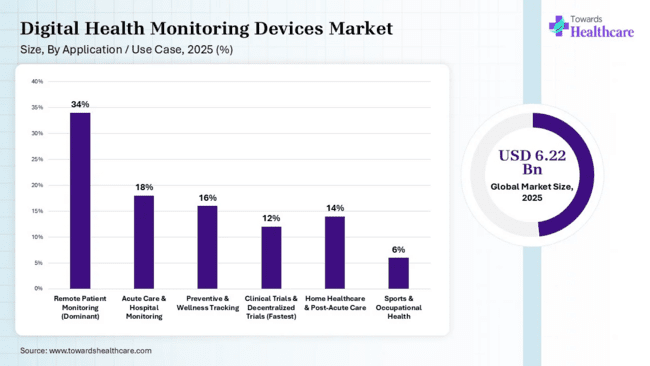
- By application/use case, the remote patient monitoring (RPM) & chronic disease management segment contributed the biggest revenue share by 34% in the market in 2025.
- By application/ use case, the clinical trials & decentralized trials segment is expected to grow at the fastest CAGR in the market during the forecast period.
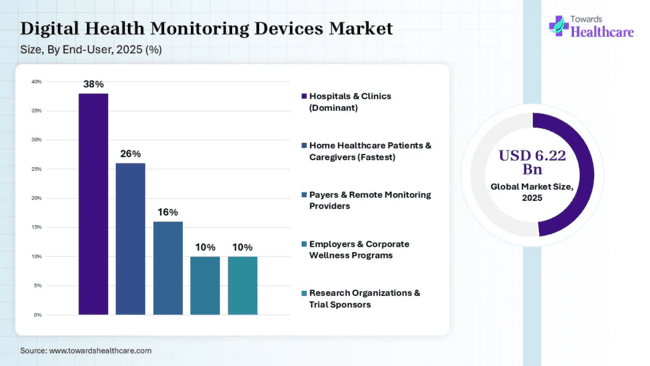
- By end-user, the hospitals & clinics segment accounted for the maximum revenue share by 38% in the market in 2025.
- By end-user, the home healthcare patients & caregivers segment is expected to expand rapidly in the market in the coming years.
You can place an order or ask any questions, please feel free to contact us at sales@towardshealthcare.com
Market Overview
The digital health monitoring devices market is revolutionized by technological integration, including the Internet of Things (IoT) and the Internet of Medical Things (IoMT), which are pivotal in healthcare in delivering smarter care. Both of these technologies have advanced features such as high-performance connectivity, precise data collection and analysis, effective automation, consistent remote monitoring, and improved decision-making. A seamless connection of medical devices enables real-time communication, while data collection and analysis ensure accurate and actionable insights. Automation streamlines processes to save time and resources, and remote monitoring allows users to continuously track devices and patients from any place. The smarter choices are made through data-driven insights and improved decision-making.
Modern Systems in Healthcare
- The Internet of Things (IoT): The IoT technology is employed across many industries, such as smart homes, manufacturing, and many others. The wide applications of IoT integration result in smart devices, improved logistics, and industrial automation. IoT shows moderate data sensitivity, and it ensures general cybersecurity. It delivers convenience and efficiency across various industries, including the digital health monitoring devices market.
- The Internet of Medical Things (IoMT): The IoMT technology has wide applications across healthcare and medical industries. The IoMT technology benefits users with remote patient monitoring solutions and connected pacemakers. IoMT shows highly sensitive medical data, and it complies with strict healthcare regulations. It improves patient care and operational workflows.
Become a valued research partner with us - https://www.towardshealthcare.com/schedule-meeting
The Digital Health Monitoring Devices Market: Regional Analysis
| Region | Share (%) | |
| North America (Dominant) | 38 | % |
| Asia Pacific (Fastest) | 26 | % |
| Europe | 22 | % |
| Latin America | 9 | % |
| Middle East & Africa | 5 | % |
North America dominated the market share by 38% in 2025, owing to advances in sensor technology and battery life, favorable reimbursement policies for telehealth services and remote patient monitoring, and integration of AI tools for early detection and predictive analytics. Digital health technologies are transforming modern healthcare, which substantially improves quality and safety across public health, clinical practice, and medical research. The digital technologies have enabled the progress of predictive analytics, personalized medicine, and remote patient monitoring. This progress is achieved through the implementation of telemedicine platforms, AI, and wearable devices.
U.S. Market Analysis
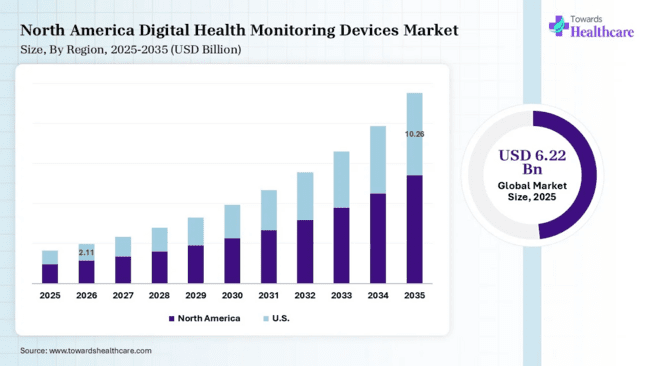
The digital health monitoring devices market in the U.S. is expected to reach USD 10.26 billion in 2035, experiencing a momentous growth, owing to the use of advanced technologies to automate documentation, augment clinical workflows, and provide predictive analytics for clinical workflows. The Digital Health Center of Excellence of the U.S. FDA aims to empower stakeholders to advance healthcare and boost high-quality digital health innovation.
Asia Pacific is expected to grow at the fastest rate in the market during the forecast period due to a shift towards value-based home care, widespread 5G adoption in countries like South Korea, China, and Singapore, and preference for home-based monitoring solutions to reduce hospital readmissions. The World Health Organization (WHO) introduced the Global Initiative on Digital Health, which is a WHO-managed network of institutions, organizations, and government technical agencies. It is committed to supporting the national digital health revolution.
India Market Trends
The digital health monitoring devices market in India is gaining traction due to AI-enabled diagnostics, the evolution of wearables, and the expansion of 5G technologies. The NITI Aayog and the Ministry of Health and Family Welfare (MOFHW) released official guidelines for telemedicine practices to offer remote consultation under the Medical Council of India and the supervision of the National Medical Commission.
Get the latest insights on life science industry segmentation with our Annual Membership: https://www.towardshealthcare.com/get-an-annual-membership
The Digital Health Monitoring Devices Market: Segmentation Analysis
Device Type Insights
| Segment | Share (%) | |
| Wearable Devices (Dominant) | 42 | % |
| Non-wearable / Home Monitoring Devices | 18 | % |
| Implantable & Insertable Monitoring Devices | 14 | % |
| Clinical / Hospital Monitoring Devices | 20 | % |
| Others | 6 | % |
The wearable devices segment dominated the digital health monitoring devices market share by 42% in 2025, owing to the transformation of the healthcare industry by enabling the detection of potential issues at an early stage, continuous tracking of vital information, and improved management of current health issues. These devices include smartwatches, medical-grade devices, and many others that reduce the need for in-person consultations, enable the early detection of medical issues, and improve personalized treatment options. A smart wristwatch tracks steps, measures heart rate, counts oxygen levels, and sleep quality, along with many other health tracking features.
The wearable patches & adhesive biosensors subsegment is expected to grow at the fastest rate in the digital health monitoring devices market during the forecast period due to the rise of Information and Communication Technology (ICT), the Internet of Medical Things (IoMT), and precision medicine that have transformed the healthcare system. The wearable electronics can address the potential challenges in the healthcare system, such as the shortage of medical staff and the high burden of medical costs. These wearable medical devices allow regular blood pressure monitoring, which is important for the diagnosis and management of patients.
Monitoring Parameter/Biomarker Insights
| Segment | Share (%) | |
| Cardiac (Dominant) | 28 | % |
| Respiratory | 14 | % |
| Metabolic (Fastest Growing) | 16 | % |
| Hemodynamic | 12 | % |
| Sleep & Activity | 11 | % |
| Neurological | 7 | % |
| Medication Adherence & Inhalation Metrics | 6 | % |
| Temperature & Others | 6 | % |
The cardiac segment led the digital health monitoring devices market share by 28% in 2025, owing to the role of digital biomarkers in monitoring health parameters in people with obesity. Periodic laboratory testing keeps track of the biochemical parameters, including an increase in glucose and cholesterol levels in the blood that lead to altered metabolic events. A pacemaker monitors heart rate and rhythm, and sends an electrical signal to normalize the heartbeat.
The metabolic segment is expected to be the fastest-growing in the digital health monitoring devices market in the coming years due to the popularity and huge adoption of non-invasive wearables, ingestible sensors, implantable sensors, and smart scales. The core functions of the non-invasive wearables in metabolism lie in the detection of trace markers in saliva, sweat, or intestinal fluid. Whereas the ingestible sensors assist in the direct monitoring of gas profiles and gut metabolites.
Technology/Sensor Type Insights
| Segment | Share (%) | |
| Optical Sensors (PPG) – Dominant | 30 | % |
| Electro-physiological Sensors (ECG, EEG) | 20 | % |
| Electrochemical Sensors (Fastest Growing) | 16 | % |
| Pressure Sensors | 12 | % |
| Motion & Inertial Sensors | 14 | % |
| Multi-modal Sensor Fusion | 8 | % |
The optical sensors (PPG) segment held the major revenue share by 30% in the digital health monitoring devices market in 2025, owing to their integral role in the development of medical diagnostic devices, and they are widely used to measure the physiology of the human body. Optical sensors provide electrical safety, excellent metrological properties, simple miniaturization, immunity to electromagnetic interference, non-invasive examination, and the ability to capture several volumes of nanometers. The use of optical sensors brings new and better methods for continuous diagnostics.
The electrochemical sensors segment is expected to witness the fastest growth in the digital health monitoring devices market over the forecast period due to the urgent demand for reliable, sensitive, quick, accurate, and handy analytical tools for clinical applications that can sense biomolecules. The electrochemical sensors are precise and sensitive methods for early diagnosis of diseases. They are essential for the survival and successful prognosis of patients.
Application/Use Case Insights
| Segment | Share (%) | |
| Remote Patient Monitoring (Dominant) | 34 | % |
| Acute Care & Hospital Monitoring | 18 | % |
| Preventive & Wellness Tracking | 16 | % |
| Clinical Trials & Decentralized Trials (Fastest) | 12 | % |
| Home Healthcare & Post-Acute Care | 14 | % |
| Sports & Occupational Health | 6 | % |
The remote patient monitoring (RPM) & chronic disease management segment contributed the biggest revenue share by 34% in the digital health monitoring devices market in 2025, owing to its integral part in reducing hospital readmissions, promoting self-care and self-monitoring, reducing costs, and improving the overall patient satisfaction rate. A remote patient monitoring platform enables healthcare professionals and practices to connect with patients and offers seamless integration with electronic health records. This platform and management allow healthcare providers to easily communicate with patients through video calls, audio, and SMS to make timely interventions.
The clinical trials & decentralized trials segment is expected to grow rapidly in the digital health monitoring devices market during the predicted timeframe due to the favorable opportunities for clinical trials enabled by software, hardware, mobile health apps, sensors, wearable devices, and telemedicine platform solutions. Implantables and ingestibles capture physiological data and track medication adherence. The prominent remote patient monitoring platforms used in clinical trials are Medidata Sensor Cloud, Science 37 RPM suite, Koneksa Health, ActiGraph, and VivoSense. They benefit from better safety monitoring, real-time data, fewer site visits, and protocol compliance.
End-User Insights
| Segment | Share (%) | |
| Hospitals & Clinics (Dominant) | 38 | % |
| Home Healthcare Patients & Caregivers (Fastest) | 26 | % |
| Payers & Remote Monitoring Providers | 16 | % |
| Employers & Corporate Wellness Programs | 10 | % |
| Research Organizations & Trial Sponsors | 10 | % |
The hospitals & clinics segment accounted for dominance in the digital health monitoring devices market share by 38% in 2025, owing to the digital health transformation, and the core roles of digital technologies for real-time inpatient monitoring, early intervention and diagnosis, remote patient monitoring, chronic disease management, and operational efficiency. The most common digital health monitoring devices used in healthcare settings are pulse oximeters, glucometers, ECG monitors, smart scales, and digital sphygmomanometers. The integration of these devices results in a great impact on clinical outcomes.
The home healthcare patients & caregivers segment is expected to expand at a rapid rate in the digital health monitoring devices market during the studied period due to improved access to care, early detection of health risks, enhanced independence, better disease management, and reduced healthcare costs. The digital health monitoring devices are beneficial to caregivers in terms of real-time alerts and safety, peace of mind, improved communication, remote monitoring capabilities, and operational efficiency.
Access our comprehensive healthcare dashboard for detailed market insights, segment breakdowns, regional performance, and company profiles: https://www.towardshealthcare.com/access-dashboard
The Digital Health Monitoring Devices Market Companies
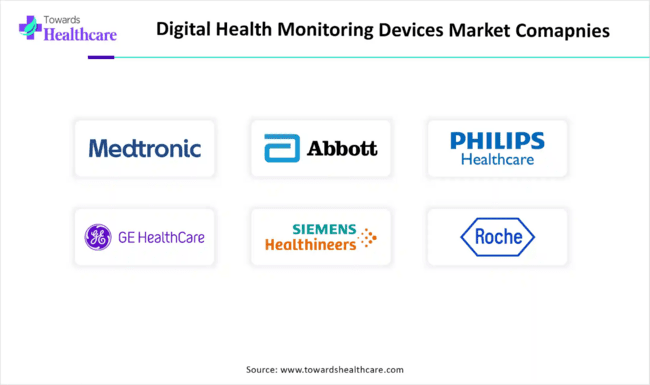
- BioTelemetry
- Withings
- Fitbit (Google)
- Apple
- Masimo
- Dexcom
- Omron Healthcare
- iRhythm Technologies
- Siemens Healthineers
- Roche Diagnostics
- Johnson & Johnson
- Boston Scientific
- ResMed
- Medtronic
- Abbott Laboratories
- Philips Healthcare
- GE Healthcare
- Garmin
- Huawei Health/Huawei Technologies
- Xiaomi (Huami/Amazfit)
Browse More Insights of Towards Healthcare:
The global oncology clinical trial monitor market size was estimated at USD 14.93 billion in 2025 and is predicted to increase from USD 15.76 billion in 2026 to approximately USD 25.6 billion by 2035, expanding at a CAGR of 5.54% from 2026 to 2035.
The heart rate monitor market size stood at US$ 2.74 billion in 2025, grew to US$ 2.96 billion in 2026, and is forecast to reach US$ 5.84 billion by 2035, expanding at a CAGR of 7.87% from 2026 to 2035.
The global medical diagnostic monitor market size was estimated at USD 2.71 billion in 2025 and is predicted to increase from USD 2.91 billion in 2026 to approximately USD 5.6 billion by 2035, expanding at a CAGR of 7.54% from 2026 to 2035.
The global home respiratory monitor market size was estimated at USD 2.55 billion in 2025 and is predicted to increase from USD 2.78 billion in 2026 to approximately USD 6.12 billion by 2035, expanding at a CAGR of 9.15% from 2026 to 2035.
The global tele-monitoring services market size was estimated at USD 30.96 billion in 2025 and is predicted to increase from USD 36.59 billion in 2026 to approximately USD 164.55 billion by 2035, expanding at a CAGR of 18.18% from 2026 to 2035.
The global fitness tracker for sleep monitoring market size is calculated at US$ 7.64 billion in 2025, grew to US$ 8.88 billion in 2026, and is projected to reach around US$ 34.15 billion by 2035. The market is expanding at a CAGR of 16.15% between 2026 and 2035.
The global gestational diabetes market size is calculated at USD 10.3 billion in 2025, grew to USD 11.24 billion in 2026, and is projected to reach around USD 22.58 billion by 2034. The market is expanding at a CAGR of 9.15% between 2024 and 2034.
The global mRNA quality monitoring market size is calculated at US$ 1.37 billion in 2025, grew to US$ 1.46 billion in 2026, and is projected to reach around US$ 2.5 billion by 2034. The market is expanding at a CAGR of 6.97% between 2024 and 2034.
The clinical perinatal software market size was estimated at USD 187.47 million in 2025 and is predicted to increase from USD 206.85 million in 2026 to approximately USD 501.48 million by 2035, expanding at a CAGR of 10.34% from 2026 to 2035.
The global AI in blood pressure monitoring market size was estimated at USD 1.23 billion in 2025 and is predicted to increase from USD 1.59 billion in 2026 to approximately USD 16.89 billion by 2035, expanding at a CAGR of 30% from 2026 to 2035.
Segments Covered in the Report
By Device Type
- Wearable devices
- Smartwatches & fitness bands with medical sensors
- Wearable patches & adhesive biosensors
- Chest straps & wearable ECG monitors
- Smart clothing & textiles
- Non-wearable/home monitoring devices
- Blood pressure monitors (digital cuff)
- Glucose monitors (CGM & SMBG)
- Pulse oximeters
- Smart scales
- Sleep monitors (under-mattress, bedside monitors)
- Smart inhalers & medication sensors
- Implantable & insertable monitoring devices
- Implantable loop recorders (ILR)/pacemaker sensors
- Implantable glucose sensors
- Clinical/hospital monitoring devices
- Multi-parameter bedside monitors
- Remote telemetry systems
- Others (clinical-grade sensors, point-of-care monitoring)
By Monitoring Parameter/Biomarker
- Cardiac (ECG/arrhythmia, heart rate variability)
- Respiratory (SpO2, respiration rate)
- Metabolic (glucose, ketones)
- Hemodynamic (blood pressure)
- Sleep & activity (sleep stages, steps)
- Neurological (EEG, movement)
- Medication adherence & inhalation metrics
- Temperature & others
By Technology/Sensor Type
- Optical sensors (PPG)
- Electro-physiological sensors (ECG, EEG)
- Electrochemical sensors (glucose, lactate)
- Pressure sensors (BP cuffs)
- Motion & inertial sensors (accelerometer, gyroscope)
- Multi-modal sensor fusion
By Application/Use Case
- Remote patient monitoring (RPM) & chronic disease management
- Acute care & hospital monitoring
- Preventive & wellness tracking
- Clinical trials & decentralized trials (digital endpoints)
- Home healthcare & post-acute care
- Sports performance & occupational health
By End-User
- Hospitals & clinics
- Home healthcare patients & caregivers
- Payers & remote monitoring service providers
- Employers & corporate wellness programs
- Research organizations & clinical trial sponsors
By Region
- North America
- U.S.
- Canada
- Asia Pacific
- China
- Japan
- India
- South Korea
- Thailand
- Europe
- Germany
- UK
- France
- Italy
- Spain
- Sweden
- Denmark
- Norway
- Latin America
- Brazil
- Mexico
- Argentina
- Middle East and Africa (MEA)
- South Africa
- UAE
- Saudi Arabia
- Kuwait
Immediate Delivery Available | Buy This Research Report Now @ https://www.towardshealthcare.com/checkout/6128
Access our exclusive, data-rich dashboard dedicated to the healthcare market - built specifically for decision-makers, strategists, and industry leaders. The dashboard features comprehensive statistical data, segment-wise market breakdowns, regional performance shares, detailed company profiles, annual updates, and much more. From market sizing to competitive intelligence, this powerful tool is one-stop solution to your gateway.
Access the Dashboard: https://www.towardshealthcare.com/access-dashboard
About Us
Towards Healthcare is a leading global provider of technological solutions, clinical research services, and advanced analytics, with a strong emphasis on life science research. Dedicated to advancing innovation in the life sciences sector, we build strategic partnerships that generate actionable insights and transformative breakthroughs. As a global strategy consulting firm, we empower life science leaders to gain a competitive edge, drive research excellence, and accelerate sustainable growth.
You can place an order or ask any questions, please feel free to contact us at sales@towardshealthcare.com
Europe Region: +44 778 256 0738
North America Region: +1 8044 4193 44
APAC Region: +91 9356 9282 04
Web: https://www.towardshealthcare.com
Our Trusted Data Partners
Precedence Research | Towards Packaging | Towards Food and Beverages | Towards Chemical and Materials | Towards Dental | Towards EV Solutions | Healthcare Webwire
Find us on social platforms: LinkedIn | Twitter | Instagram | Medium | Pinterest


Legal Disclaimer:
EIN Presswire provides this news content "as is" without warranty of any kind. We do not accept any responsibility or liability for the accuracy, content, images, videos, licenses, completeness, legality, or reliability of the information contained in this article. If you have any complaints or copyright issues related to this article, kindly contact the author above.
